Me again. This isn't the promised Kosovo blog, or pictures from Bosnia or Kosovo, since I am without my laptop, but instead I hope I can share some interesting stories from Brazil, or at least let my parents know I am still alive...
I am currently in Sao Paulo, Brazil's largest city, with something around 20 million people inhabiting the greater area. The sheer scale is something I've never contemplated before, and after five days I am still no closer to understanding what this much urban-ness means. A lot of people and a lot of concrete...
I am staying with my good friend Joao, who is my co-year at UWCAd. With us are Gabriel, my british 'secondo' (who is also incidentally the only person I have ever met who I am aware of having elevenses and afternoon tea as a daily fixture) and Davide, another Italian co-year, both also from UWCAd. We have all arrived early to Brazil, as the main reason for us coming is that along with a number of other students from the college, we will be spending three weeks volunteering with a number of organisations in Sao Paulo and Rio de Janeiro. For the first week and a half we will be working with a children's centre in a favela in Sao Paulo, as well as with a homeless charity called 'Minha rua minha casa' ('My street, my home'), and then in Rio de Janeiro we will be primarily visiting and helping at a children's home, which will be especially interesting as this organisation receives very little volunteer support, compared to some of the more commerical 'voluntourism' outfits there are around.
That starts on monday and I shall report in due course. Before that, though, I have had the chance to relax in a very nice house, with great hospitality provided by the Baltazar family. As well as a couple of late nights spent playing on the Wii, we have been able to sample a cultured, vibrant city. On Wednesday we visited a sprawling park set amidst a vast backdrop of skyscrapers, and enjoyed the winter sun with Joao and some of his friends, followed by a 5pm lunch at a shopping mall. It was a nice opportunity to speak to other young people our age, and as usual I am humbled by how well so many people speak English, and how much of an effort they make to accomodate us. I am actually picking up quite a bit of Portuguese (although the Brazilian 'dialect' varies from Portuguese Portuguese much more than American English differs from British English) but it just reminds me not only of how embarassingly ignorant, but also how poor our education system is that it does not push us to learn any languages. In my opinion it would be quite possible for children as soon as they start school to learn at least one extra language, eventually gaining knowledge of even three or four over their school career. Ultimately it is us who will lose out, as on a global scale how can we expect our graduates to compete with so many other, more talented people...? Anyway, rant over.
Yesterday (thursday) was another lovely afternoon. We also experienced the buses for the first time, as previously Joao's parents had given us lifts everywhere. After meeting two of Joao's friends, Carol and Mariza, we were treated to what I can only describe in cliche' fashion as a 'rollercoaster ride', so much did the twisting and potholed roads rattle our bones. But it was very fun, nonetheless. We went to one of the kind of centres of the city, Avenue Paulista, which is certainly an urban hub of activity. Here we went to one of the events of an ongoing international animated short film festival ('Anima Mundi') and watched a series of short films hailing from as close as Rio de Janeiro and as far as Poland and Egypt. After this we went to enjoy some cafe culture for a short while, which ended up being about 4 hours, as we enjoyed basking in the hustle and bustle, watching the street sellers going about their business, the police duely taking their bribe from the brothel owner and the odd busker passing our way. We sampled the local 'Caipirinha' as well as the familiar greasy chips. Leo, another friend of Joao, joined us and added some appropriate Latin American communist spirit to the conversation.
Today (friday) was another lazy day, with us only getting out of the house by 4 (following a swim and a sunbathe), and instead of Joao, who had to work on the dreaded 'Extended Essay' for the IB, we were babysat by Carol and Mariza, who we had met the previous day. We went to another 'centre' of Sao Paulo, although this time a more modern one, again by shaky bus, to the Latin America 'Memorial', a collection of museums, offices, libraries and performance spaces dedicated to the history of Latin America. We were again here for the animated short film festival, and were treated to some gems from Quebec, Denmark and Iran, among others. Sadly, the problem with getting your arse into gear so late does mean that you tend to get less done, and this way of being was upheld by us having to leave as we were having a big dinner back at the house, a bit like Sunday lunch... but at dinnertime and with no meat (since Joao's family is also vegetarian).
So far I have seen very little of the city, and I think that when we start our work we will see yet another side, but I can definitely say that Sao Paulo has a lot, almost too much in fact, to offer.
Just a few interesting things:
-Billboard advertising is illegal within the city boundary. A highly civilised idea.
-Police cars have red lights instead of blue. I actually think blue lights make more sense. Especially in Sao Paulo at night you can see a hell of a lot of rear-break lights...
-Brazilian law dictates that all passengers flying to and from Brazil are legally permitted 32kg of luggage at no extra charge. Another highly intelligent law.
Oh yeah and so far I have not taken any photos, as I have not taken my camera out due to fear of pickpockets. Actually I get the impression that as long as you are not hanging your camera from a nice thin strap out of your vision on the outside of your rucksack, like any good 'gringo' should, there is not too much of a problem with theft. But we shall see... When or if I do take any photos, I shall dutifully upload them.
Friday, 29 July 2011

Tuesday, 14 June 2011
Rest of the course
Friday 10th June
Today we started with with a talk from a guy from the Nansen Dialogue Centre, an NGO working on improving dialogue between the different ethnic groups in BiH and also the region as a whole. It was very interesting when he pointed out the difference between dialogue and debate. Although obvious I had never really thought about this before, that for example when you are in a dialogue you listen to see what the other is saying, when you are debating you listen to see how you can respond with your point. Essentially debate is point scoring and selfish, since you always think about whether you look good, or whether your point of opinion has 'won', whereas in dialogue it isn't bad if you change your opinion, in fact it is a sign of maturity to accept when you are wrong and when something else makes more sense... I think many politicians could learn from this.
After lunch Annukka led a session on transitional justice, the difference between retributive justice, which looks back on what's happened, versus retroactive, which looks back as well as forward, engaging conflicting parties in dialogue. This obviously is quite relevant with cases such as Mladic being arrested... Following this we had a talk from a woman from the OSCE, the Organisation for Cooperation and Security in Europe, about education as a security measure, which also linked in to stuff the man from the Nansen Dialogue Centre had said about how schools can be used as great ways for resolving conflicts, or at least trying to, for example previously how following the war schools were all completely and utterly divided, whereas now they are starting 'Two schools under one roof' in BiH and even some occasional shared lessons (the UWC in Mostar is a great example of this as it also shares a building with one of these systems, so in effect there are three schools under the same roof - Croat, Bosnian and UWC). The final talk was from an american man, Kendal Palmer, who in fact talked about the Northern Ireland conflict and specifically Belfast as a divided city. This was especially interesting to me as theoretically I should know about it yet in schools in the UK we are taught literally nothing about it...
Saturday 11th June
Today we went on a field trip to visit Sarajevo. After a two hour drive through spectacular mountains and lakes we got to the city where we picked up our tour guides. It's very interesting how the first thing they said was how they didn't like to be talking about the war, but since our tour was about Sarajevo in the war they had to. I suppose it makes sense, but stuff like that shouldn't be forgotten or brushed under the carpet...
First we visited the tunnel that connected the city of Sarajevo to the rest of free Bosnia during the seige by Serbian forces, where all people, Serbs, Croats and Bosniaks of Sarajevo were victims. We were able to walk in 25 metres of the tunnel, but it actually went originally for 800 metres. It was about a metre wide and a metre and a half high and was literally incredible that every single thing, electricity, armaments, food, all had to be brought through here. We watched a video on what life was like during the siege and it was quite powerful. Since the Serbian forces surrounded the city, there was one central part of Sarajevo known as 'sniper's alley'. This was essentially a region of Sarajevo where Serbian snipers were on the hills on both sides and so could shoot anyone who crossed, which was necessary as there was only one point to get water, the brewery, where natural spring was, and people on the east side had to walk 8km to get it. The video saw people running in zig zag so as to avoid fire, almost like a game as the sniper tried to keep up with the person. It is scary what people will do when they are simply 'following orders'. And it is also remarkable how resilient humans can be. After this we explored Sarajevo's Ottoman old town, where we went to the national historical museum of BiH and also had lunch in traditional style Turkish restaurant. I bought the all important thing, a BiH football shirt (a fake, but good one... and actually what's bigger here is Man Utd and Liverpool shirts...) Afterwards we carried on exploring the streets, and moved into the newer areas, and I can say that Sarajevo seems a very pleasant, cosmopolitan city, and although there are still scars it seems to be recovering well.
Sunday 12th June
The final day. If I'm honest we probably should've timed it so that the field trip to Sarajevo was the last thing, like a reward, also since it was the end of the week everyone was exhausted, but since it was a Sunday there would be stuff closed (there are many churches as well as mosques) so it didn't make much sense to visit then...
Anyway we started with a presentation from a very interesting talk from Sasha, an activist and organiser of 'Women in Black' on both sexism and the phenomena of rape in conflicts. She used the example of how demilitarisation is the one of the best ways to achieve equality, for example in Serbia, where militarism encourages patriarchy and vice versa, and often the church is used as a centre for encouraging this militarism. She also very interestingly pointed out that the strongest militarisation often occurs in peace time, and this is why it is so dangerous. The group she worked for led an ultimately successful campaign to remove conscription in Serbia and now there is a professional army, so no longer is everyone exposed to the patriarchal system.
After lunch one of our facilitators Alen, from BiH, led a workshop about the role of youth in peace building. He talked about his experiences prior to UWC with Save the Children and we looked at how young people and children are better placed, since they have not had the same scars as their parents, to bring peace to post conflict zones.
Faced with a depleting number since so many people had already left, we had our closing ceremony in the afternoon and then spent the evening relaxing in a cafe by the river.
Monday 13th June
Departure day. The college arranged for four of us to be picked up by car where we were taken to Sarajevo airport and then me to the bus station, where I was picked up by my co-year Nikolina, and her dad, who drove me to their house in the nearby town of Pale. Interestingly enough this town, which is part of 'eastern Sarajevo' part of the autonomous 'Republika Srbska', is where family of both Mladic and Karadzic, two Serbian war criminals, live. It was also the capital of Republika Srbska during the war. We had a walk round and now it is a fast growing new town, with a pleasant central square but if I'm honest it was a bit too new to have much character. Although at least there is still plenty of cafe culture. We met some of Nikolina's friends and had a nice stroll around, past her school and the Serbian university there.
I'm writing this on Tuesday 14th June, and this afternoon we will go to Sarajevo, and then in the evening I will get the overnight bus to Pristina, in Kosovo. Because of problems with my second year in Belgrade, I am staying an extra two days in Kosovo.
Today we started with with a talk from a guy from the Nansen Dialogue Centre, an NGO working on improving dialogue between the different ethnic groups in BiH and also the region as a whole. It was very interesting when he pointed out the difference between dialogue and debate. Although obvious I had never really thought about this before, that for example when you are in a dialogue you listen to see what the other is saying, when you are debating you listen to see how you can respond with your point. Essentially debate is point scoring and selfish, since you always think about whether you look good, or whether your point of opinion has 'won', whereas in dialogue it isn't bad if you change your opinion, in fact it is a sign of maturity to accept when you are wrong and when something else makes more sense... I think many politicians could learn from this.
After lunch Annukka led a session on transitional justice, the difference between retributive justice, which looks back on what's happened, versus retroactive, which looks back as well as forward, engaging conflicting parties in dialogue. This obviously is quite relevant with cases such as Mladic being arrested... Following this we had a talk from a woman from the OSCE, the Organisation for Cooperation and Security in Europe, about education as a security measure, which also linked in to stuff the man from the Nansen Dialogue Centre had said about how schools can be used as great ways for resolving conflicts, or at least trying to, for example previously how following the war schools were all completely and utterly divided, whereas now they are starting 'Two schools under one roof' in BiH and even some occasional shared lessons (the UWC in Mostar is a great example of this as it also shares a building with one of these systems, so in effect there are three schools under the same roof - Croat, Bosnian and UWC). The final talk was from an american man, Kendal Palmer, who in fact talked about the Northern Ireland conflict and specifically Belfast as a divided city. This was especially interesting to me as theoretically I should know about it yet in schools in the UK we are taught literally nothing about it...
Saturday 11th June
Today we went on a field trip to visit Sarajevo. After a two hour drive through spectacular mountains and lakes we got to the city where we picked up our tour guides. It's very interesting how the first thing they said was how they didn't like to be talking about the war, but since our tour was about Sarajevo in the war they had to. I suppose it makes sense, but stuff like that shouldn't be forgotten or brushed under the carpet...
First we visited the tunnel that connected the city of Sarajevo to the rest of free Bosnia during the seige by Serbian forces, where all people, Serbs, Croats and Bosniaks of Sarajevo were victims. We were able to walk in 25 metres of the tunnel, but it actually went originally for 800 metres. It was about a metre wide and a metre and a half high and was literally incredible that every single thing, electricity, armaments, food, all had to be brought through here. We watched a video on what life was like during the siege and it was quite powerful. Since the Serbian forces surrounded the city, there was one central part of Sarajevo known as 'sniper's alley'. This was essentially a region of Sarajevo where Serbian snipers were on the hills on both sides and so could shoot anyone who crossed, which was necessary as there was only one point to get water, the brewery, where natural spring was, and people on the east side had to walk 8km to get it. The video saw people running in zig zag so as to avoid fire, almost like a game as the sniper tried to keep up with the person. It is scary what people will do when they are simply 'following orders'. And it is also remarkable how resilient humans can be. After this we explored Sarajevo's Ottoman old town, where we went to the national historical museum of BiH and also had lunch in traditional style Turkish restaurant. I bought the all important thing, a BiH football shirt (a fake, but good one... and actually what's bigger here is Man Utd and Liverpool shirts...) Afterwards we carried on exploring the streets, and moved into the newer areas, and I can say that Sarajevo seems a very pleasant, cosmopolitan city, and although there are still scars it seems to be recovering well.
Sunday 12th June
The final day. If I'm honest we probably should've timed it so that the field trip to Sarajevo was the last thing, like a reward, also since it was the end of the week everyone was exhausted, but since it was a Sunday there would be stuff closed (there are many churches as well as mosques) so it didn't make much sense to visit then...
Anyway we started with a presentation from a very interesting talk from Sasha, an activist and organiser of 'Women in Black' on both sexism and the phenomena of rape in conflicts. She used the example of how demilitarisation is the one of the best ways to achieve equality, for example in Serbia, where militarism encourages patriarchy and vice versa, and often the church is used as a centre for encouraging this militarism. She also very interestingly pointed out that the strongest militarisation often occurs in peace time, and this is why it is so dangerous. The group she worked for led an ultimately successful campaign to remove conscription in Serbia and now there is a professional army, so no longer is everyone exposed to the patriarchal system.
After lunch one of our facilitators Alen, from BiH, led a workshop about the role of youth in peace building. He talked about his experiences prior to UWC with Save the Children and we looked at how young people and children are better placed, since they have not had the same scars as their parents, to bring peace to post conflict zones.
Faced with a depleting number since so many people had already left, we had our closing ceremony in the afternoon and then spent the evening relaxing in a cafe by the river.
Monday 13th June
Departure day. The college arranged for four of us to be picked up by car where we were taken to Sarajevo airport and then me to the bus station, where I was picked up by my co-year Nikolina, and her dad, who drove me to their house in the nearby town of Pale. Interestingly enough this town, which is part of 'eastern Sarajevo' part of the autonomous 'Republika Srbska', is where family of both Mladic and Karadzic, two Serbian war criminals, live. It was also the capital of Republika Srbska during the war. We had a walk round and now it is a fast growing new town, with a pleasant central square but if I'm honest it was a bit too new to have much character. Although at least there is still plenty of cafe culture. We met some of Nikolina's friends and had a nice stroll around, past her school and the Serbian university there.
I'm writing this on Tuesday 14th June, and this afternoon we will go to Sarajevo, and then in the evening I will get the overnight bus to Pristina, in Kosovo. Because of problems with my second year in Belgrade, I am staying an extra two days in Kosovo.
Monday, 13 June 2011
Bosnia and Herzegovina
Ok, this post isn't about what I did, but important and hopefully interesting information about why Bosnia and Herzegovina has such problems and why the college is there and why I was there.
What exactly was I doing in Mostar? Well, I was attending what UWC call a 'short course', which does exactly what it says on the tin. They are basically ways that UWC can spread the movement of UWC to more people and hopefully spread the values and ethos, of peace and a sustainable future. These short courses vary massivly in shape and size, this one I was doing was organised by the UWC College in Mostar, one of the newest (and most interesting in my opinion) colleges of UWC, with only 5 years of existence. It was originally founded as a five year NGO, an educational project in an ethnically divided, conflict-scarred zone, however due to its successes at helping to heal wounds (I will go into this in a bit) it has now been established as an official school. The school is the only UWC to be located in a proper urban area (my college in Duino is near Trieste but actually in a small village. There is also a new UWC in Maastricht in the Netherlands but this is not what I would consider to be a UWC, like the one in Singapore many of the students simply paid their way in, and this spoils the UWC experience for those that got in on merit... I digress) and as such reflects massively the culture and feel of Balkan and Bosnian life. There is a very high proportion of local (as in from BiH - Bosnia and Herzegovina) students, and I know that there can be problems of the locals just hanging out with each other since there are so many, but this is not all of them and the problem is decreasing and does not stop others from having an amazing experience. Fellow geordie Megan is my co-year there and she absolutely loves it.
Going back to short courses, as I was saying this one was organised by UWCiM and the Finnish Cultural Foundation, who paid our travel expenses and funded all the speakers and activities. It was on the subject of Peace and Conflict Resolution, bringing together UWC students and local high school students of Croat, Serb and Bosnian ethnicity to try and help us to learn about the subject in a very real situation. Other short courses are organised by UWC national committees (the bodies in each country responsible for making selections to send students to the various UWCs) or other colleges. Some have UWC students facilitating, taking part, or both, such as this one, and always include young people from the local area.
A bit about BiH. Located in the cradle of Croatia (our soon to be newest member to the club), with Serbia on its eastern border and Montenegro to the south. Following WWII, BiH was part of Yugoslavia. This was created by Josep Broz Tito, who led the resistance to Nazi occupation in WWII. Tito established Yugolsavia as a communist federation of 6 republics, formed because of historical (mainly mediaeval kingdoms)existences prior to occupation by the Ottoman and Austro-Hungarian empires and also the existence of ethnic identities linked to these often poorly defined mediaeval kingdoms (in that no one knew exactly where the borders were, what made people different etc). These republics were Serbia, Slovenia, Croatia, Bosnia and Herzegovina, Macedonia and Montenegro. Tito saw that to make a united, powerful Slavic state these ethnic tensions had to disappear. Although there had been problems between these ethnicities during the war, Tito and his regime brutally suppressed all talk or reference to any differences between peoples in Yugoslavia. Whilst most of the republics were quite ethnically homogeneous, BiH differed in that it had many Croats, Serbs and Muslims (Bosniaks).
Tito rejected Stalin and presided over the non-alignment movement during the cold war, consisting of nations that did not want to be part of either the west or the east. Being non aligned allowed Yugoslavia's economy to grow strong in the 60s and 70s and to promote socialism without being distracted by the cold war. The UWC of the Adriatic, the one I attend was founded in 1982, mainly because of its proximity to Yugoslavia, and the eastern bloc, in an attempt to bring young people together from a divided world. In the 1980s the economy began to stagnate as more and more money was spent on armaments and defence, for fear of either the west or east invading.
After Tito's death in 1980, and with the economy not so strong, Yugoslavia started its decline. Slobodan Milosevic, a senior communist was initially hailed as a saviour for Yugoslavia and became president of the federation in 1989. However, he basically pulled out the pin of the ethnic time bomb, when he made a speech saying that Serbs were being repressed by Albanians in the autonomous region (which acted effectively like a republic) of Kosovo, part of Serbia. This went against the taboo of not speaking of nationality or ethnicity in Yugoslavia, and effectively opened the floodgates to a tide of conflicts that had been building for quite some time, especially in recent years. Atrocities committed in WWII by various groups on others and ideas of glorious pasts, as well as fear spread nationalism and resulted in some hugely destructive ethnic wars during the 1990s.
BiH was where perhaps the worst atrocities were committed in the war between 1992 and 1995. This was caused by Serb political parties and Croat political parties declaring the relative independence from BiH, supported by the relative armies of Croatia and Yugoslavia (effectively Serbian). The democratically elected government of BiH did not accept these declarations of independence and so issued a referendum on secession as a WHOLE national sovereign state of BiH, including Serb and Croat peoples, from what remained of Yugoslavia. The people voted a majority in favour of secession, since a majority were Bosniak, or Muslim. Armies were mobilised by all sides and although Bosnian (I will use the term Bosnian, rather than ethnic term Bosniak, since there were both Serbs and Croats who fought for a united BiH) defence forces (who were poorly organised and badly equipped) in fact (according to the BBC) fired the first shots on some Serbian people, the Serbian army was the first to launch proper military action, moving to take control of all the areas of BiH where Serbs were the majority. Bosnian defences were really poor and effectively the government of BiH ceased to control the nation. Bosnian and Croat forces initially teamed up to fight against Serbia, however the Croatian army also turned against Bosnian forces as Croatia wanted land.
These conflicts, between all three groups, led to huge displacement of people (estimated at more than 2 million) and thousands of deaths, casualties and huge social scars which will lead the country divided for a long time. Perhaps the most (in)famous was the seige of the capital of BiH, Sarajevo. The city in fact had a very mixed population, with around 70% of mixed marriages between Serbs, Croats or Bosniaks. Serbian forces surrounded the city and under the command of Ratko Mladic, pummelled the city for three years. There was just one way in and out of the city, a small tunnel underneath the airport, which was UN controlled territory. This linked what remained of 'free' BiH to the city. Atrocities were committed by all sides. In 1995, the Dayton Peace accords were signed, mostly bringing the fighting to an end. This led BiH mostly as it is today, divided into two parts, Republika of Srpska and the Federation of Bosnia and Herzegovina. These operate as generally autonomous regions of one nation.
Next blog I will return to normal diary mode.
What exactly was I doing in Mostar? Well, I was attending what UWC call a 'short course', which does exactly what it says on the tin. They are basically ways that UWC can spread the movement of UWC to more people and hopefully spread the values and ethos, of peace and a sustainable future. These short courses vary massivly in shape and size, this one I was doing was organised by the UWC College in Mostar, one of the newest (and most interesting in my opinion) colleges of UWC, with only 5 years of existence. It was originally founded as a five year NGO, an educational project in an ethnically divided, conflict-scarred zone, however due to its successes at helping to heal wounds (I will go into this in a bit) it has now been established as an official school. The school is the only UWC to be located in a proper urban area (my college in Duino is near Trieste but actually in a small village. There is also a new UWC in Maastricht in the Netherlands but this is not what I would consider to be a UWC, like the one in Singapore many of the students simply paid their way in, and this spoils the UWC experience for those that got in on merit... I digress) and as such reflects massively the culture and feel of Balkan and Bosnian life. There is a very high proportion of local (as in from BiH - Bosnia and Herzegovina) students, and I know that there can be problems of the locals just hanging out with each other since there are so many, but this is not all of them and the problem is decreasing and does not stop others from having an amazing experience. Fellow geordie Megan is my co-year there and she absolutely loves it.
Going back to short courses, as I was saying this one was organised by UWCiM and the Finnish Cultural Foundation, who paid our travel expenses and funded all the speakers and activities. It was on the subject of Peace and Conflict Resolution, bringing together UWC students and local high school students of Croat, Serb and Bosnian ethnicity to try and help us to learn about the subject in a very real situation. Other short courses are organised by UWC national committees (the bodies in each country responsible for making selections to send students to the various UWCs) or other colleges. Some have UWC students facilitating, taking part, or both, such as this one, and always include young people from the local area.
A bit about BiH. Located in the cradle of Croatia (our soon to be newest member to the club), with Serbia on its eastern border and Montenegro to the south. Following WWII, BiH was part of Yugoslavia. This was created by Josep Broz Tito, who led the resistance to Nazi occupation in WWII. Tito established Yugolsavia as a communist federation of 6 republics, formed because of historical (mainly mediaeval kingdoms)existences prior to occupation by the Ottoman and Austro-Hungarian empires and also the existence of ethnic identities linked to these often poorly defined mediaeval kingdoms (in that no one knew exactly where the borders were, what made people different etc). These republics were Serbia, Slovenia, Croatia, Bosnia and Herzegovina, Macedonia and Montenegro. Tito saw that to make a united, powerful Slavic state these ethnic tensions had to disappear. Although there had been problems between these ethnicities during the war, Tito and his regime brutally suppressed all talk or reference to any differences between peoples in Yugoslavia. Whilst most of the republics were quite ethnically homogeneous, BiH differed in that it had many Croats, Serbs and Muslims (Bosniaks).
Tito rejected Stalin and presided over the non-alignment movement during the cold war, consisting of nations that did not want to be part of either the west or the east. Being non aligned allowed Yugoslavia's economy to grow strong in the 60s and 70s and to promote socialism without being distracted by the cold war. The UWC of the Adriatic, the one I attend was founded in 1982, mainly because of its proximity to Yugoslavia, and the eastern bloc, in an attempt to bring young people together from a divided world. In the 1980s the economy began to stagnate as more and more money was spent on armaments and defence, for fear of either the west or east invading.
After Tito's death in 1980, and with the economy not so strong, Yugoslavia started its decline. Slobodan Milosevic, a senior communist was initially hailed as a saviour for Yugoslavia and became president of the federation in 1989. However, he basically pulled out the pin of the ethnic time bomb, when he made a speech saying that Serbs were being repressed by Albanians in the autonomous region (which acted effectively like a republic) of Kosovo, part of Serbia. This went against the taboo of not speaking of nationality or ethnicity in Yugoslavia, and effectively opened the floodgates to a tide of conflicts that had been building for quite some time, especially in recent years. Atrocities committed in WWII by various groups on others and ideas of glorious pasts, as well as fear spread nationalism and resulted in some hugely destructive ethnic wars during the 1990s.
BiH was where perhaps the worst atrocities were committed in the war between 1992 and 1995. This was caused by Serb political parties and Croat political parties declaring the relative independence from BiH, supported by the relative armies of Croatia and Yugoslavia (effectively Serbian). The democratically elected government of BiH did not accept these declarations of independence and so issued a referendum on secession as a WHOLE national sovereign state of BiH, including Serb and Croat peoples, from what remained of Yugoslavia. The people voted a majority in favour of secession, since a majority were Bosniak, or Muslim. Armies were mobilised by all sides and although Bosnian (I will use the term Bosnian, rather than ethnic term Bosniak, since there were both Serbs and Croats who fought for a united BiH) defence forces (who were poorly organised and badly equipped) in fact (according to the BBC) fired the first shots on some Serbian people, the Serbian army was the first to launch proper military action, moving to take control of all the areas of BiH where Serbs were the majority. Bosnian defences were really poor and effectively the government of BiH ceased to control the nation. Bosnian and Croat forces initially teamed up to fight against Serbia, however the Croatian army also turned against Bosnian forces as Croatia wanted land.
These conflicts, between all three groups, led to huge displacement of people (estimated at more than 2 million) and thousands of deaths, casualties and huge social scars which will lead the country divided for a long time. Perhaps the most (in)famous was the seige of the capital of BiH, Sarajevo. The city in fact had a very mixed population, with around 70% of mixed marriages between Serbs, Croats or Bosniaks. Serbian forces surrounded the city and under the command of Ratko Mladic, pummelled the city for three years. There was just one way in and out of the city, a small tunnel underneath the airport, which was UN controlled territory. This linked what remained of 'free' BiH to the city. Atrocities were committed by all sides. In 1995, the Dayton Peace accords were signed, mostly bringing the fighting to an end. This led BiH mostly as it is today, divided into two parts, Republika of Srpska and the Federation of Bosnia and Herzegovina. These operate as generally autonomous regions of one nation.
Next blog I will return to normal diary mode.
Thursday, 9 June 2011
The week so far...
Me again. I have had a fascinating, intense, exhausting three first days here at the UWC in Mostar. I'll try to recap them as efficiently (efficiently since I want to be short, but not cut corners, as in still make it interesting...) as I can.
Sunday 5th June
I suppose breakfast kind of reflected the geographical location in which it was being served, as in not quite european (the two options consisted of bread and jam, and tea.) Now I know they're stingy with breakfast on the continent... actually for 15 euros it was pretty good.
I took the bus to Zadar bus station (sadly didn't get to see the sea organ) from where I took the 10 o clock bus to Split, Croatia's second largest city, further down the coast. After this (stunning - sea, mountains) journey I had a couple of hours for lunch in the ancient centre of split. My lonely planet informed me that the locals are proud of being the bearers of the Roman emperor Diocletian´s huge deathplace (literally, it´s basically a palace that he built to die and be buried in). I then took the bus from the bustling sea port to Mostar, another almost four hour journey. Sadly I didn´t get a stamp from the border guard, and I didn´t really feel like asking... It was really interesting the transition from Croatia to Bosnia and Herzegovina (it´s official name is this, however for space let´s just call it Bosnia), almost as soon as you cross you can see that there is less money around, roads, buildings, cars. Also really oddly there are cars parked for kilometres upon kilometres (sorry guys, Europe´s turning me metric...) which have just been abandoned. I later asked a Bosnian, and they told me that since there is no infrastructure for disposal of cars, people just dump them. And then they use them for spare parts.
I arrived early in the evnening to Mostar bus station, expecting to be met. This was not the case, in the end I waited for a while, chatted to a young guy who went to Australia during the war, and then eventually resigned myself to walking to the college (luckily the college is pretty well known, and especially tourist places speak the lingo). Fortunately, as I was walking I bumped into a group of slightly out of place looking people, who recognised my UWC hoodie and all was well...
Monday 6th June
We started off with icebreaker games and introductions; in total there are 70 of us, about 20 UWC students (about half of whom - no idea if that´s grammatically correct - are from Bosnia or the Balkans) and the rest are all local high school students, with the exception of a handful of students from a government sponsored IB school in Banja Luka, the capital of the Republika Srbska, the other autonomous region of Bosnia and Herzegovina (it´s incredibly complicated, I shall have a go at explaining at a later point). After lunch, Annukka, the Finnish organiser of the summer course (she is a graduate of UWC USA; the course is funded by a Finnish organisation)gave an introduction to Peace studies, and then we were thrown into the deep end by the college´s (acronomym UWCiM, literally UWC in Mostar) history teacher giving us a three hour talk on the history of the Balkan regions, from mediaeval times until today! In the evening we had a nice time relaxing at a local bar called ´Old Man´s´, so named because normally it is full of old men...
Tuesday 7th June
Annukka led the morning workshop, about tools for conflict prevention. In the afternoon we were joined by Janine di Giovanni, who talked to us about her career and reporting from conflict zones. We then analysed some of her articles in groups, and very bravely of her she asked us when we were all back together again in the hall to give our critiques. In the evening we ended up doing creative stuff, I chose to do some what´s known as ´Theatre of the Oppressed´, I have come across it before and it´s a really interesting way of raising powerful issues. Since we were being filmed for a documentary on the summer course, we didn´t do any potentially controversial issues, let´s say sexual abuse could be an example. We basically showed the scenario of a university Dean (I played the corrupt Dean,character modelled on Tony Blair crossed with Malfoy, not a nice fellow) getting his daughter good grades by putting pressure on the daughter´s teacher. But the twist is that we repeated our performance, and during the second showing, the audience could stop the play at any point to switch themselves with one of the characters (except the protagonists, the teacher or the daughter, so either swapped with me or one of the other students in the class) to try and resolve the solution, without a corrupted and/or conflict solution being the end result. In the end, no resolution was found, but at least it showed how effective this theatre can be at raising awareness of issues.
Wednesday 8th June
Our first lecture of the day was from Annuka again (by the way she has various degrees in Peace and Conflict studies and politics, in case you were wondering about her mandate...) on the subject of UNderstanding conflict and conflict management, focusing on how differently different people see conflicts, and that the only way you can hope to peacefully resolve one is by understanding (not necessarily agreeing with) all the viewpoints of the parties involved. THen we had a fascinating insight from a Balkans analyst, Srecko Latal, on the developments politically, economically and socially from pre war to the present day (he was interestingly highly critical of Paddy Ashdown, when he was UN high representative of the country, as Ashdown basically instead of letting Bosnians take control, added more layers of bureaucracy and took away control from the Bosnian people. He was much more complimentary of Lady Ashton in her recent peace efforts in the region as EU foreign representative) It seems like Bosnia has some interesting times ahead, especially politically (by the way I am forcing myself not to go into much detail, for example about political problems etc, for ease of reading, but if you would like to know more you can either post a comment or ask questions when we next see each other...) Following this we had the afternoon off, taking buses donated ´From the People of Japan´, to a truly spectacular place named Kravice. Basically it is a large waterfall area, where you can swim in the various streams at the foot of the cliffs and just have a great time, enjoying the sun and swimming in the crystal clear water of the river... In the evening programme we watched a (at times harrowing) documentary by an anthropologist following the lives of residents in a village in northern Bosnia during the war, showing how at first the Muslims and Croats were united against the Serb enemy (at the time Sarajevo, Bosnia´s capital was under seige from the Serbs)however for whatever reason, Croatia turned against the (majority in the country) muslims. We also watched the documentary when the anthropologist returned six years after the war to see what had happened to the people she met. It really showed just how devastatingly unnecessary and utterly destructive the war was. Although it was good, since it focused mainly on Croat attacks on Muslims, there was general consensus that we also need to acknowledge that the Muslims committed similar atrocities, as did the Serbs.
Thursday 9th June
The day´s proceedings were mainly taken up by people from the Red Cross, who were running workshops on International Humanitarian Law. Through a series of interactive workshops and scenarios we came to learn what IHL is, and what its purpose is. IHL basically is only applicable in times of armed conflict, and aims to protect the needs and dignity of those involved. Human Rights Law is what is applicable in peace time. Interestingly I had not realised how much the Red Cross´s work focuses on IHL in times of conflict. Following lunch, a graceful old gentleman came to talk to us about the importance of dignity and its role in avoding conflict. He spoke little English, since his work consists of training teachers and students around the country, but managed to engage us in thinking about ourselves and how important dignity is (the most effective thing was when we looked at the case of Elizabeth Eckford and Grace Lorch, the black student who was nearly mobbed by a crowd determined not to let her be the first student at a previously all white high school, and the white woman who led her to safety. By looking at why Grace Lorch did what she did, and cosnidering things such as making up Lorch´s biography, profiling why the conflict occurred, among others, it really made all of us think about compassion and dignity). After this workshop, which the man very tactfully finished an hour early (on top of the packed programme - from 8 till 8 most days we don´t go back to the residences where we´re staying, especially because it is quite a walk from the school to the residence - it was hot and people were tired) a big group of us (when I say ´us´and I am not talking about in the workshops or scheduled stuff such as the trip to the waterfall, I normally mean the UWC students, local UWC students from Mostar, and the students from the IB school in Banja Luka, with a couple of high school students) went to the old bank building. The school building the UWC uses is basically the ´gymnasium´(grammar school) which was completely bombed in the war, but was rebuilt with donations from various european governments (although not ours) and is now a truly magnificent building to study in. This is situated on ´Spanish Square´, a major junction in the road that seperates the Muslim and Croat sides of the city (prior to the war these divisions did not exist). Burnt shells of buildings can be seen on both sides of the road, still left over from the war. THis is normally because of lack of funds and/or ownership issues (many people left the country during the war and haven´t returned). In the case of the old bank building (or actually it was pretty new, it was only just finished at the start of the war in Bosnia in 1992), the bank is currently in turmoil and so has left it completely untouched. You can literally walk in the 15 (approx) storey building right off the street, into where the rotating doors should be, into what used to be a large welcome lobby. However everything is just burnt out or vandalised. The first floor is the only one that seems to have avoided being trashed, my supposition is that this was too low to be of strategic use (snipers easy to spot, trees blocked vision of gunners etc) so avoided being emptied. Or maybe it was the only floor in operation since the builidng was new. It is strewn with papers, computer manuals, smashed screens, desks, everywhere there is glass since the building was coated in glass. We went to the top and saw a spectacular view, Mostar is nestled in mountains, but you can still see the destruction, fifteen years on.
A great day was capped after dinner by a man from Finland who was part of the Finnish NGO, SaferGlobe, who gave a talk about the arms trade, not just on Finland (who is surprisingly bad on the arms trade) but the world. The man (whose name I don´t recall, the Fins are fond of their syllables...) was kind of young, in his thirties and was clearly dedicated to his work. And the work he does is really important. In broken English he managed to explain to us just how many armed conflicts there are in the world (this website shows all the ones as of 2009, and you can look at the world map showing all conflicts since 1975, and you can explore different types of conflict and look at the conflict histories of each country)we looked at how much money is spent on the weapons trade (this website shows the realtime increasing debt of the USA, there is also a link to other countries´. We discussed how powerful the armaments industry is, especially in suppressing awareness raising (becuase if more people were aware, there would definitely be much stronger political will to clamp down on these companies, as we have seen political will in Germany especially clamp down on nuclear power)and also the damages on societies following armed conflicts, as well as the impact on guns on society and also the growing ´de-personalisation´ of armaments, as weapons (for example a man sitting clicking a mouse to fire a missile from an unarmed drone does not really think about who he is killing). What makes me disgusted is that we have one of the world´s largest weapons companies, BAE systems in Britain, so really we are disgustingly hypocritical when talking about human rights, since we aid so many abusers of rights. Although the timing wasn´t great (evening was the only time since the guy had flown literally hours before to Sarajevo, and is going back six hours after giving the talk, as he is running a scout camp!) and the guy wasn´t so used to public speaking, it was a really insightful evening.
ok, that´s me for now, sorry about the length,I kind of got progressively longer, I will try harder next time... but it´s just there´s so much to write about!
I will also include a brief summary of the causes of, events and consequences of the ethnic wars in 1992 - 1995, as it really is worth knowing about.
I will upload photos when I´ve taken ones of all the stuff I mentioned (eg school building).
Robin
Sunday 5th June
I suppose breakfast kind of reflected the geographical location in which it was being served, as in not quite european (the two options consisted of bread and jam, and tea.) Now I know they're stingy with breakfast on the continent... actually for 15 euros it was pretty good.
I took the bus to Zadar bus station (sadly didn't get to see the sea organ) from where I took the 10 o clock bus to Split, Croatia's second largest city, further down the coast. After this (stunning - sea, mountains) journey I had a couple of hours for lunch in the ancient centre of split. My lonely planet informed me that the locals are proud of being the bearers of the Roman emperor Diocletian´s huge deathplace (literally, it´s basically a palace that he built to die and be buried in). I then took the bus from the bustling sea port to Mostar, another almost four hour journey. Sadly I didn´t get a stamp from the border guard, and I didn´t really feel like asking... It was really interesting the transition from Croatia to Bosnia and Herzegovina (it´s official name is this, however for space let´s just call it Bosnia), almost as soon as you cross you can see that there is less money around, roads, buildings, cars. Also really oddly there are cars parked for kilometres upon kilometres (sorry guys, Europe´s turning me metric...) which have just been abandoned. I later asked a Bosnian, and they told me that since there is no infrastructure for disposal of cars, people just dump them. And then they use them for spare parts.
I arrived early in the evnening to Mostar bus station, expecting to be met. This was not the case, in the end I waited for a while, chatted to a young guy who went to Australia during the war, and then eventually resigned myself to walking to the college (luckily the college is pretty well known, and especially tourist places speak the lingo). Fortunately, as I was walking I bumped into a group of slightly out of place looking people, who recognised my UWC hoodie and all was well...
Monday 6th June
We started off with icebreaker games and introductions; in total there are 70 of us, about 20 UWC students (about half of whom - no idea if that´s grammatically correct - are from Bosnia or the Balkans) and the rest are all local high school students, with the exception of a handful of students from a government sponsored IB school in Banja Luka, the capital of the Republika Srbska, the other autonomous region of Bosnia and Herzegovina (it´s incredibly complicated, I shall have a go at explaining at a later point). After lunch, Annukka, the Finnish organiser of the summer course (she is a graduate of UWC USA; the course is funded by a Finnish organisation)gave an introduction to Peace studies, and then we were thrown into the deep end by the college´s (acronomym UWCiM, literally UWC in Mostar) history teacher giving us a three hour talk on the history of the Balkan regions, from mediaeval times until today! In the evening we had a nice time relaxing at a local bar called ´Old Man´s´, so named because normally it is full of old men...
Tuesday 7th June
Annukka led the morning workshop, about tools for conflict prevention. In the afternoon we were joined by Janine di Giovanni, who talked to us about her career and reporting from conflict zones. We then analysed some of her articles in groups, and very bravely of her she asked us when we were all back together again in the hall to give our critiques. In the evening we ended up doing creative stuff, I chose to do some what´s known as ´Theatre of the Oppressed´, I have come across it before and it´s a really interesting way of raising powerful issues. Since we were being filmed for a documentary on the summer course, we didn´t do any potentially controversial issues, let´s say sexual abuse could be an example. We basically showed the scenario of a university Dean (I played the corrupt Dean,character modelled on Tony Blair crossed with Malfoy, not a nice fellow) getting his daughter good grades by putting pressure on the daughter´s teacher. But the twist is that we repeated our performance, and during the second showing, the audience could stop the play at any point to switch themselves with one of the characters (except the protagonists, the teacher or the daughter, so either swapped with me or one of the other students in the class) to try and resolve the solution, without a corrupted and/or conflict solution being the end result. In the end, no resolution was found, but at least it showed how effective this theatre can be at raising awareness of issues.
Wednesday 8th June
Our first lecture of the day was from Annuka again (by the way she has various degrees in Peace and Conflict studies and politics, in case you were wondering about her mandate...) on the subject of UNderstanding conflict and conflict management, focusing on how differently different people see conflicts, and that the only way you can hope to peacefully resolve one is by understanding (not necessarily agreeing with) all the viewpoints of the parties involved. THen we had a fascinating insight from a Balkans analyst, Srecko Latal, on the developments politically, economically and socially from pre war to the present day (he was interestingly highly critical of Paddy Ashdown, when he was UN high representative of the country, as Ashdown basically instead of letting Bosnians take control, added more layers of bureaucracy and took away control from the Bosnian people. He was much more complimentary of Lady Ashton in her recent peace efforts in the region as EU foreign representative) It seems like Bosnia has some interesting times ahead, especially politically (by the way I am forcing myself not to go into much detail, for example about political problems etc, for ease of reading, but if you would like to know more you can either post a comment or ask questions when we next see each other...) Following this we had the afternoon off, taking buses donated ´From the People of Japan´, to a truly spectacular place named Kravice. Basically it is a large waterfall area, where you can swim in the various streams at the foot of the cliffs and just have a great time, enjoying the sun and swimming in the crystal clear water of the river... In the evening programme we watched a (at times harrowing) documentary by an anthropologist following the lives of residents in a village in northern Bosnia during the war, showing how at first the Muslims and Croats were united against the Serb enemy (at the time Sarajevo, Bosnia´s capital was under seige from the Serbs)however for whatever reason, Croatia turned against the (majority in the country) muslims. We also watched the documentary when the anthropologist returned six years after the war to see what had happened to the people she met. It really showed just how devastatingly unnecessary and utterly destructive the war was. Although it was good, since it focused mainly on Croat attacks on Muslims, there was general consensus that we also need to acknowledge that the Muslims committed similar atrocities, as did the Serbs.
Thursday 9th June
The day´s proceedings were mainly taken up by people from the Red Cross, who were running workshops on International Humanitarian Law. Through a series of interactive workshops and scenarios we came to learn what IHL is, and what its purpose is. IHL basically is only applicable in times of armed conflict, and aims to protect the needs and dignity of those involved. Human Rights Law is what is applicable in peace time. Interestingly I had not realised how much the Red Cross´s work focuses on IHL in times of conflict. Following lunch, a graceful old gentleman came to talk to us about the importance of dignity and its role in avoding conflict. He spoke little English, since his work consists of training teachers and students around the country, but managed to engage us in thinking about ourselves and how important dignity is (the most effective thing was when we looked at the case of Elizabeth Eckford and Grace Lorch, the black student who was nearly mobbed by a crowd determined not to let her be the first student at a previously all white high school, and the white woman who led her to safety. By looking at why Grace Lorch did what she did, and cosnidering things such as making up Lorch´s biography, profiling why the conflict occurred, among others, it really made all of us think about compassion and dignity). After this workshop, which the man very tactfully finished an hour early (on top of the packed programme - from 8 till 8 most days we don´t go back to the residences where we´re staying, especially because it is quite a walk from the school to the residence - it was hot and people were tired) a big group of us (when I say ´us´and I am not talking about in the workshops or scheduled stuff such as the trip to the waterfall, I normally mean the UWC students, local UWC students from Mostar, and the students from the IB school in Banja Luka, with a couple of high school students) went to the old bank building. The school building the UWC uses is basically the ´gymnasium´(grammar school) which was completely bombed in the war, but was rebuilt with donations from various european governments (although not ours) and is now a truly magnificent building to study in. This is situated on ´Spanish Square´, a major junction in the road that seperates the Muslim and Croat sides of the city (prior to the war these divisions did not exist). Burnt shells of buildings can be seen on both sides of the road, still left over from the war. THis is normally because of lack of funds and/or ownership issues (many people left the country during the war and haven´t returned). In the case of the old bank building (or actually it was pretty new, it was only just finished at the start of the war in Bosnia in 1992), the bank is currently in turmoil and so has left it completely untouched. You can literally walk in the 15 (approx) storey building right off the street, into where the rotating doors should be, into what used to be a large welcome lobby. However everything is just burnt out or vandalised. The first floor is the only one that seems to have avoided being trashed, my supposition is that this was too low to be of strategic use (snipers easy to spot, trees blocked vision of gunners etc) so avoided being emptied. Or maybe it was the only floor in operation since the builidng was new. It is strewn with papers, computer manuals, smashed screens, desks, everywhere there is glass since the building was coated in glass. We went to the top and saw a spectacular view, Mostar is nestled in mountains, but you can still see the destruction, fifteen years on.
A great day was capped after dinner by a man from Finland who was part of the Finnish NGO, SaferGlobe, who gave a talk about the arms trade, not just on Finland (who is surprisingly bad on the arms trade) but the world. The man (whose name I don´t recall, the Fins are fond of their syllables...) was kind of young, in his thirties and was clearly dedicated to his work. And the work he does is really important. In broken English he managed to explain to us just how many armed conflicts there are in the world (this website shows all the ones as of 2009, and you can look at the world map showing all conflicts since 1975, and you can explore different types of conflict and look at the conflict histories of each country)we looked at how much money is spent on the weapons trade (this website shows the realtime increasing debt of the USA, there is also a link to other countries´. We discussed how powerful the armaments industry is, especially in suppressing awareness raising (becuase if more people were aware, there would definitely be much stronger political will to clamp down on these companies, as we have seen political will in Germany especially clamp down on nuclear power)and also the damages on societies following armed conflicts, as well as the impact on guns on society and also the growing ´de-personalisation´ of armaments, as weapons (for example a man sitting clicking a mouse to fire a missile from an unarmed drone does not really think about who he is killing). What makes me disgusted is that we have one of the world´s largest weapons companies, BAE systems in Britain, so really we are disgustingly hypocritical when talking about human rights, since we aid so many abusers of rights. Although the timing wasn´t great (evening was the only time since the guy had flown literally hours before to Sarajevo, and is going back six hours after giving the talk, as he is running a scout camp!) and the guy wasn´t so used to public speaking, it was a really insightful evening.
ok, that´s me for now, sorry about the length,I kind of got progressively longer, I will try harder next time... but it´s just there´s so much to write about!
I will also include a brief summary of the causes of, events and consequences of the ethnic wars in 1992 - 1995, as it really is worth knowing about.
I will upload photos when I´ve taken ones of all the stuff I mentioned (eg school building).
Robin
Saturday, 4 June 2011
Hello again everyone. Hmm well anyway I have decided to trial a new format of my blog (aka actually short posts) on my current trip. I am at the moment sitting in the very comfortable youth hostel in Zadar, Croatia. Today I got the plane from Stansted to Zadar airport (we were the ONLY plane - it seemed like the airport hadn't changed since communism...). I managed this despite the best efforts of both my train to stansted this morning... And just to describe what I am doing in this neck of the woods, I am on my way to Mostar in Bosnia, where I will be taking part in a short course (one week) on peace and conflict resolution organised by the UWC there, with other UWC students and local high school students. After that I will briefly stop off at Nikolina's house (my co year) in Sarajevo, and then Marko(my second year) in Belgrade before spending five days with my co year Egzon in Kosovo, and then come home...
Today after arriving I wondered through the surprisingly beautiful old town of Zadar and then found myself confusedly following Google maps' instructions to the youth hostel (with a bit of help from the good old lonely planet as well ;) ) and on the your's walk I found many a relaxed person bathing in the (much clearer than trieste) waters of the adriatic, to the backdrop of the Croatian islands. After finding my rudimentary but blissfully empty hostel dorm, I enquired about local eateries, and ended up eating at 'Nana Rima' a local pizzeria. Although I ordered a takeaway I in the end stayed talking to two of the waiters for over an hour. One of them the older one, Kruna, knew an astonishing amount about British history and was able to tell me more about the history of Elizabethan England than most average British people (including myself) would know. In my first day, although at times stressful (travelling with ryanair is never not...) I have found a really friendly place and people.
Tomorrow I get up early and I will try to see the famous sea organ of Zadar, however if not I will simply get the bus to Split (further down the Croatian coast) and from there to Mostar. Over and out.
P.s. apologies for the lack of nice, readable formatting, however since I do not have my laptop I am writing this on my phone (actually quite useful - with the hostel's WiFi I can access everything on my phone, meaning I don't have to lug (or worry about) a laptop...)
Today after arriving I wondered through the surprisingly beautiful old town of Zadar and then found myself confusedly following Google maps' instructions to the youth hostel (with a bit of help from the good old lonely planet as well ;) ) and on the your's walk I found many a relaxed person bathing in the (much clearer than trieste) waters of the adriatic, to the backdrop of the Croatian islands. After finding my rudimentary but blissfully empty hostel dorm, I enquired about local eateries, and ended up eating at 'Nana Rima' a local pizzeria. Although I ordered a takeaway I in the end stayed talking to two of the waiters for over an hour. One of them the older one, Kruna, knew an astonishing amount about British history and was able to tell me more about the history of Elizabethan England than most average British people (including myself) would know. In my first day, although at times stressful (travelling with ryanair is never not...) I have found a really friendly place and people.
Tomorrow I get up early and I will try to see the famous sea organ of Zadar, however if not I will simply get the bus to Split (further down the Croatian coast) and from there to Mostar. Over and out.
P.s. apologies for the lack of nice, readable formatting, however since I do not have my laptop I am writing this on my phone (actually quite useful - with the hostel's WiFi I can access everything on my phone, meaning I don't have to lug (or worry about) a laptop...)
Wednesday, 26 January 2011
A new year...
No, your eyes do not deceive you, this is actually another blog post from me. And no your computers did not break last October, I did stop writing these blogs. I enjoyed writing them a lot: they gave me an excellent opportunity to reflect, to think about what I was doing and most importantly to share in detail my experiences here at the United World College of the Adriatic. I kept on intending to write the next post after the climbing trip, however being me I kept on procrastinating and as time passed the amount of stuff to write amassed. Combine with this the immense fatigue that develops (going to bed late + heavy workload + mentally intense lifestyle - e.g. not much time for slobbing = very very tired) and as just mentioned a lot of work, I didn’t get round to writing it.
But I have decided to restart the blog in a more reader friendly way, in other words more concise! And also more pictures (I now have a new camera, although typically I left it at home… it should be with me soon) will hopefully mean you can get an idea of what life is like here for me without spending an hour reading...
To start with I’ll give some of the highlights (I kept a note of what went on last term) of last term post-climbing trip (the subject of my last blog):
Thursday 30th September – Sunday 3rd October – First Long Weekend (Turin)
This was the first of two long weekends in the first term. (Basically instead of any ‘half term holiday’ like in the UK, in this first term, we have two weekends with an extra day of holiday added) Francesco, my Italian co-year, invited me to stay with him at his home in Torino for the weekend. After school on the Thursday, we took the (remarkably cheap and efficient) train and when a casa loro, I had the most comfortable night’s sleep since being in Italy.
Over the weekend I went to Francesco’s old school where I met some of his teachers, met his really kind friends (especially I enjoyed meeting George, of Romanian descent, who was pretty much fluent in English and whose aim is to learn all the Latin based languages, learn all the UN languages and become a diplomat. From my conversations I quite confidently think he will succeed), twice ate in pizzerias that did amazing pizza (the best so far) and I also experienced that famous Italian hospitality, especially where it comes to food. Francesco also showed me quite a bit of Torino, which, from my brief time, seems like a large, but still alive, city, with fascinating (like most of Italy) architecture and history. And if you are wandering about the driving, having watched the Italian Job (the original Michael Caine film, not the shoddy American remake) yes, I can testify that drivers in Torino are possibly the scariest I have experienced. Rules of driving: drive as fast as possible then slam on brakes. If space drive into it. Honk horn whenever possible.
Over the weekend I went to Francesco’s old school where I met some of his teachers, met his really kind friends (especially I enjoyed meeting George, of Romanian descent, who was pretty much fluent in English and whose aim is to learn all the Latin based languages, learn all the UN languages and become a diplomat. From my conversations I quite confidently think he will succeed), twice ate in pizzerias that did amazing pizza (the best so far) and I also experienced that famous Italian hospitality, especially where it comes to food. Francesco also showed me quite a bit of Torino, which, from my brief time, seems like a large, but still alive, city, with fascinating (like most of Italy) architecture and history. And if you are wandering about the driving, having watched the Italian Job (the original Michael Caine film, not the shoddy American remake) yes, I can testify that drivers in Torino are possibly the scariest I have experienced. Rules of driving: drive as fast as possible then slam on brakes. If space drive into it. Honk horn whenever possible.
All in all it was a lovely weekend.
Saturday 9th October - Padua
This Saturday was the second of the ‘cultural visits’ organised by Henry, the college’s World Arts and Cultures teacher. Padua (or Padova in Italian) is an ancient Roman city (well now not that much Roman stuff remains, but still lots of buildings from all time periods since then) in the neighbouring province of Veneto, and is about three hours’ coach ride away. We started the tour with Giotto’s frescoes of biblical scenes in the Arena Chapel, which really were remarkable, how after 700 years they have remained in relatively good condition.
We also visited the Basilica of St. Anthony of Padua, a major catholic pilgrimage and also the home to a Franciscan monastery, and actually I enjoyed the day a lot more than I did with Venice. Obviously in Venice I wasn’t feeling well, but Padua felt a lot more alive. It was still beautiful (although obviously not so as Venice) but there were real Paduans (aren’t they something from Star Wars?) going about their daily lives, and the prices weren’t at least with a 200% mark up on normal retail price… I ended the day with a small group of us sitting on the huge grassed, oval shaped park thing in the centre of the city, just sitting in the sun…
We also visited the Basilica of St. Anthony of Padua, a major catholic pilgrimage and also the home to a Franciscan monastery, and actually I enjoyed the day a lot more than I did with Venice. Obviously in Venice I wasn’t feeling well, but Padua felt a lot more alive. It was still beautiful (although obviously not so as Venice) but there were real Paduans (aren’t they something from Star Wars?) going about their daily lives, and the prices weren’t at least with a 200% mark up on normal retail price… I ended the day with a small group of us sitting on the huge grassed, oval shaped park thing in the centre of the city, just sitting in the sun…

The Basilica (all the photos here are taken with my phone)
Wednesday 13th October – My birthday!
My birthday! Slightly before midnight (on the Tuesday), my roommates gave me their birthday present. Some boxers (as in underwear) with a crown on it, for the ‘British King’. At midnight, as is the tradition, I went to the day room of my residence, Foresteria (Fore for short), where people were waiting to sing me happy birthday. I was then really overwhelmed when I received no fewer than FIVE birthday cakes from various different people. Those of you who know me well will know that I don’t like chocolate, however at this time I really didn’t mind that all the cakes were chocolate, as it was so kind that people had gone to the effort of making them. I then opened my cards from home, and also found cards from people from the college. In the morning, after finishing my Italian homework, I found Gabriel (my second-year) and Hannah (sort of my second year as well, seeing as her mum’s British) making breakfast for me. Some Eggy bread and freshly squeezed orange juice. At lunchtime, everyone sang happy birthday in mensa (the Italian word for canteen), another college tradition. For the evening meal I didn’t have a repetition of this, as Sana (first year, India) and a few others had decided to cook me a meal for dinner. What an amazing curry! My evening ended with playing poker with some of the Italians and then watching a film, ‘The Box’, it didn’t matter if it was a terrible film, I had an absolutely amazing day. This was in contrast to before the birthday, when I had been quite apprehensive as I’ve never celebrated a birthday away from home before, so when everybody was so kind and nice to make me have a great day, it was even more appreciated.

Me in the middle.
Friday 22nd October – Sunday 24th October - Arezzo
This weekend a group of about 30 students from the college (accompanied by Viviana, one of the Italian teachers, who is also an alumnus of the college) and our head teacher, Peter, drove six or seven hours to the Tuscan countryside Arezzo, where we stayed in a hotel (wasn’t great, but space away from the college is always appreciated) prior to going into the mountains the next day. The purpose of our visit was to attend a conference at a monastery (another two hours away, right in the mountains), which was organised by a Catholic political party, on the subject of European relations with Africa, but for me was a good opportunity to practice Italian (the students who came who were not Italian native speakers were offered to come because they were good at Italian, and learn more about Italian history and culture. The food was INCREDIBLE. Four or five courses every meal, and home-produced wine, combined with being in the middle of the Tuscan hills, listening to speakers in Italian, certainly made me feel engaged in a culture.
Friday 29th October – Monday 1st November – Second long weekend (Cycling in Slovenia)
This was the second of the two long weekends. Originally the group of us was: Raza (my room-mate, Mauritius), Virginia (first-year, Italy), Hannah (second-year, Malta) and Moritz (first-year, Sud Tirol - Italy/Austria). We decided to go cycling in nearby Slovenia (when I say ‘decided’, it wasn’t impromptu, we had been planning for at least a week), and cycling in nearby Slovenia is what we did, borrowing the school’s bikes and tents. The difference between Slovenia and Italy is immediately noticeable. Slovenia seems very new, as if a lot of settlements have only been built in the last five or so years. At the same time the quality of life seems incredibly relaxed, along the way we passed many a person sitting in their garden, next to their vegetable plot/autumn-leaved vineyard, pumpkins out in style in preparation for Halloween, and because it was harvest season. The first night we camped, and the second, after seeing some spectacular underground caves in Skocjanske ( http://www.park-skocjanske-jame.si/eng/photogallery_1.shtml ) we slept indoors in an agriturismo (kind of like farms crossed with small hotels), which was in fact featured in the New York Times. Again, the food was delicious, the starter of walnut soup probably being the most palatable.
The ride home was a much simpler affair than the outbound journey, as much of it was downhill, and we even managed to get back in time on the Sunday for me to watch Newcastle, on some shady website, destroy Sunderland 5-1. Getting back on the Sunday also meant that I had time to revise for an upcoming biology test and catch up with work on the Monday, which was the day off for the long weekend.

As you can see the tent was literally freezing...
Saturday 6th November – Art Marathon
In the evening, from 8 till 12 midnight, we had an ‘art marathon’. Basically the whole school building (ground floor lecture room and computer room; first and second floors 8 small to medium sized classrooms on each floor) was taken over and most of the rooms had some sort of art installation in. In one room was a group of people with guitars and percussion, improvising, in another photos (it’s hard to describe), and among all of them perhaps the best was in the auditorium (not actually in the school building), where for three solid hours Josh (first-year, South Africa) played piano, Theis (first-year, Denmark) played the drums and Teresa (second-year, Czech Republic) danced, all completely improvised. It’s kind of hard to say what it was like, but it was really beautiful...
Thursday 11th November – Remembrance Day
By this date pretty much all of our history course had been about world war one. I had also seen the trenches nearby and in the hills slightly further afield. So being the day on which the atrocities of the first world war came to an end (or, at least the day on which fighting stopped), 92 years ago; being away from home and thinking more about the history of where I come from (in other words Britain) and how ridiculous a war it was, as are all the current ones we are in, I thought that I wanted to do something. A few days earlier I went to my tutor, Lydia, and asked if she would support me in having what’s called a personal day. These are basically days that the college has which people can request if need be, and you speak to your tutor about it and usually the college (very impressively) trusts you. Depending on your tutor, if you just feel completely overwhelmed by life, and need to walk along the coast somewhere (as I have heard of people doing) then you can request one of these days. So anyway, I did so far this day and went into the nearby hills to go and be amongst the trenches, which were the Italian – Austrian front. Later on I was told by the director of studies, Mike, that this personal day had been “an indulgence”, that I shouldn’t have been allowed it just because I couldn’t be bothered to go to school, which I was very insulted by, but being British didn’t say anything in response (I know I shouldn’t feel I have to justify myself to him, but whatevs…). I don’t really know what else to write about the day, just the fact that I was standing where thousands of men had been forced to die and forced to kill for mere metres of land, and that the beautiful plants and animals surrounding me were all living memorials, almost (for they can only be from after the war, as the upheaval made the land bare) to those who fell.

My improvised poppy.


One of the natural caves which was used as a trench


A more man-made trench

Friday 12th November – EE Show
Tonight was the EE show. EE stands for Extended Essay and the show was basically put on by us primi (first years) for our secondi (second years) to congratulate them on finishing their EEs (required and graded as part of the IB, basically a mini thesis on a subject of their choice). I somehow ended up organising the parodies, which took the process of a mini story going from residence to residence and mimicking (affectionately, of course) as many students as possible. The rest of the show was full of music and dance acts, which were almost all very high quality, all the more surprising since we had only had our first full rehearsal two hours before the show was due to start, and at that moment it was indeed a shambles…
If I find any videos of it on youtube, I'll post the link.
Sunday 14th November – Orienteering in Venice
Today saw me return to Venice, although not in the usual tourist capacity. In fact I had somehow ended up going with the orienteering group (it is available as a physical activity at the college, as part of the IB) to the annual race even held there. It was certainly an unusual way to see Venice, although the race only took half an hour for me, due to the fact that I was in the beginners category, meaning I spend the rest of the day lolling around with Christian (my co-year, Indonesia).
Friday 19th November – Saturday 21st – Mum’s visit
This was a busy weekend, but I’ll try my best to keep it short. Mum arrived, with her good friend Shelagh and her daughter Natty, to come and visit me. Seeing mum for the first time in almost three months certainly was strange. Just that I had grown unaccustomed to it. I took them to Trieste for the evening, where we went to the pizzeria Vulcania, recommended by Gabriele, my Italian room-mate, as being the best pizzeria in town. I haven’t found anywhere that would make me disagree. The next day, following a tour of the school and a bit of the village, mum and I made a giant apple crumble for the commonwealth lunch, that Gabriel, my second year from Britain. I’d spoken to him about this and it wasn’t really that we felt any affinity to the commonwealth, just that we’d seen the Latini, Italian, Francophone etc having their dinners, so we decided to make an excuse to have one to include us. It consequently meant that we could eat from countries such as India, Singapore, Pakistan, Kenya, Tanzania, Canada, Hong Kong, etc. Everyone enjoyed it, and it was also a really good opportunity for mum to meet some really good people (because we were all happy in one place) and everyone enjoyed meeting mum, too.
On Sunday mum and Shelagh got the plane in the early afternoon, so I escorted them to the little airport of Trieste, and said a tearful goodbye. It really was so good to see her, but then it was worse when she was gone, because then you miss home even more, especially as I had been laden down with crumpets, sherbet lemons and British DVDs…
In the evening Gabriel and I gave a presentation for the ‘Focus’ session, which happens every Sunday evening, our one was titled ‘The Not So United Kingdom’. We covered the cultural and historic differences between England, Britain, the UK, Scotland, Wales, Ireland, Northern Ireland, and I hope people found it informative.
In the evening Gabriel and I gave a presentation for the ‘Focus’ session, which happens every Sunday evening, our one was titled ‘The Not So United Kingdom’. We covered the cultural and historic differences between England, Britain, the UK, Scotland, Wales, Ireland, Northern Ireland, and I hope people found it informative.
Friday 26th – Sunday 28th November - Modena
This weekend I went with Francesco (who I stayed with in Torino) and Davide (another of our co-years) to his Davide’s home in Modena. A while back I had seen an advert for Italia Rugby somewhere about their upcoming games. When I saw that Fiji (nb: where I was born) was on the fixture list, and playing in Modena. This just happens to be Davide’s city, and rugby happens to be his favourite sport, and the rest, as they say, is history. On the Saturday we went to the stadium (with me proudly wearing my Fiji rugby shirt), where the atmosphere was, interestingly enough, very civilised (nothing like the Italian football ultras). At half time I managed to cross the stadium to where I could see the Fiji flag, and introduced myself to some of the fans. I sat there for the rest of the game, 17 of us vs. 16,000 Italy fans! We didn’t actually win, but at least we could take solace in the fact that we scored the only try…

Did I mention that Davide's dad owns (and cooks in) a restaurant? The above was my second helping of the same meal...

Me with my fellow-place-of-birth mates!
Monday 6th December – San Nicolo
In this region of Italy (and it seems to be a very local tradition) they celebrate ‘San Nicolo’ or Saint Nicolas’ Day ( http://it.wikipedia.org/wiki/San_Nicolò ). In Duino, the village throughout which our college finds it spread across, the normal tradition is to meet in the Piazza, where all the villagers come together, especially children from the local schools, and sing carols, meet San Nicolo himself, and generally have a nice time. However, the weather being not great (i.e. a bit of rain, but really not that much) and Italians being Italians (they frown on me if I ever go outside with slightly damp hair and not wearing a coat when it is below 15 Celsius is a big No-No) they had to move the ceremony inside a building in the primary school, and it was still fun, but (I imagine) lacked the atmosphere of being outside next to the giant Christmas tree. At least there was plenty of panetone.
Sunday 12th December – Indonesia Fundraising
I started the day off by going to a ‘British Brunch’. Basically Helen (who is the ‘Director of Student Life’ and also teaches Biology) had arranged for me and my second-year, Gabriel, as well as Hannah (second-year from Malta, but half British) to go round to hers for a British brunch. We ended up staying for almost 4 hours talking about this and that and consuming the food Helen had brought over just before term in September (she basically loads her car up from Tesco and then drives through Europe to the college).
After an hour’s kickabout in the basketball courts I went to the (rather large) Christmas market in Trieste. Basically, to raise money for the relief effort in Indonesia, we had decided to sell pottery from the school’s pottery studio (so it was free in the first place, as stuff always gets made, and people also made loads of extra mugs and plates etc to sell). Even though I arrived at about 5 on a Sunday afternoon things were still really busy. Loads of us were there helping, either the Italians on the stall, selling the pottery, or us singing to attract attention (and also to spread the goodwill…), or some of us simply wandering around the market (was an excellent opportunity for Christmas presents, especially local stuff). In the end we managed to raise €461, which was really fantastic, and what was so impressive to me is that it was all completely organised by the students (apart from Pete and Tony, the teachers, who drove people to the market at the start of the day and Pete who picked people up at the end of the day), especially those who were there from 7in the morning till 9 at night, so I’d just like to say well done.
Monday 13th December – Concert in Trieste
Another really nice day: after school Signe (my co-year, Denmark) and I baked biscuits and cakes for our social service the following day. Naturally I made Victoria Sponge. Signe then said about the concerts that she goes to on Mondays, organised by Rimma (our residence tutor for Fore), who gets free tickets (somehow) for up to 8 people from the college to the classical music performances held on Mondays in a theatre in Trieste. We watched various performances, and whilst I can’t recall the names, the performances were lovely and relaxing, to the extent where I fell asleep!
Thursday 16th December – Last day of term
Well this day was a relief, I think, for everyone, teachers and students. The last day of term. In the end I had to skip my first lesson (Chemistry – all the others I had been given permission to skip) for last minute preparations, and then got the bus at 9 to the train station in Monfalcone. A whole group of us was there, travelling to Venice Marco Polo airport, which was nice, and eventually, after much travelling and sleeping, and stress caused by the easyjet shoot-to-kills (the people who go around checking for anybody they suspect might have oversize hand luggage or too many bags. In the end I had to go through both security and boarding the plane with 8 layers on – a t-shirt, three hoodies, two fleeces, a coat and a ski-jacket…) I got into London at 6, and then stayed the night with our good friend Hilary, who kindly hosted me for the night.

Me + 8 layers = two fingers in the face of easyJet.
(interesting point - in my experience easyjet are worse than Ryanair...)
It felt both strange and a relief to be back. When I say strange, I mean because everybody is speaking English with an English accent again (although having said, central London is not the best example for English speaking places, one of the amazing things about it…) and you are in a place you recognise yet haven’t been there for so long (similar feeling to when I got back home in Newcastle). What was even stranger was that I kept seeing people and thinking ‘oh they look just like so and so…’
When I say a relief, because I was tired, drained, missing friends and family and really missed my own comfy bed!
In the end I had an amazing holiday, just seeing friends and family, and also just not doing stuff (which is important after the college), but I wont bore you with a blog post about that. The next post, I promise, will be a lot shorter than this. This was only longer as I was trying to summarise the most memorable events of three months into as little words as possible. I still didn’t do that right, but hope you enjoyed reading it.
Robin
Thursday, 7 October 2010
Blog 15 (Dolomites Trip) Friday 24th – Sunday 26th October
Sorry I’m so far behind, I’ve been quite busy, anyway, this blog post is about the trip that I went on to the dolomites, which the school goes on every year. It is for people who do climbing as their physical activity, and is run by Anne, the chemistry teacher. The people who went on were: Me (primo, UK), Francesco (primo, Italy), Petra (prima, Croatia), Pablo (secondo, Mexico), Patrick (secondo, Canada), Lorenzo (primo, Italy), Nancy (prima, Singapore), Prodpran (prima, Thailand), Anna (prima, Canada), Marcela (seconda, Brazil), Alex (secondo, Belgium), Marton (primo, Hungary), Seva (prima, Lithuania), Signes (prima, Denmark) and Job (primo, Netherlands). Aila (prima, Finland) was supposed to come but she was ill. I really felt so sorry for her, we all did.
On Friday I woke at 6, although in reality I hadn’t been asleep for the past hour due to some ridiculous snoring. I managed to stumble into the shower, and then get a piece of bread for breakfast, the only thing possible as there was no milk.
On the van I slept for an almost glorious three hours, before waking gradually to find simply stunning mountains overshadowing us in the (relatively) tiny minibus. As I drifted between sleeping and not sleeping, new mountains would appear out of the mist, while other peaks disappeared round corners or into fog.
After a brief stop off to the toilet just outside the main city in the area, Cortina, we reached the starting point for the day’s adventure. A car park that would normally cater for skiers in the winter, close to both a cable car station up the road and across the road a ski run with those little ski lift things that you sit on and you get pulled up by.
After a little walk up the slope, we reached the proper starting point, just past a now crumbling world war one hospital in the foot of the mountain, which is the INSERT. The dolomites area is literally steeped in history, with large amounts of fighting between Italy and Austria-Hungary over the border, being fought here. We found the start of the via Ferata, essentially where the mountain went really steep, which was marked by steel cables.
Basically via Ferata means ‘iron way’, and what has been done is steel (originally iron, hence the name ‘iron way’) cables have been put on many of the mountains in the area which allow you to scale a mountain in a way otherwise impossible, due to the steepness and precariousness of the ascent. About every metre or so is a peg anchored into the rock, to which the main steel cable feeds through. This means that if you were to fall you would only fall about a metre as your harness (oh yeah I forgot to mention that, everyone has a standard climbing harness, with two clips attached to short ropes, which are in turn attached to the harness) would catch you. It also means that you wouldn’t knock everyone over like dominoes. This course seemed pretty much brand new, and as it turned out it was. Anne (the Chemistry teacher who runs the climbing activity, and who has organised this trip for pretty much the last 20 years. She really has dedicated her life to the UWC movement, to Atlantic college in the seventies and then UWCAd from its opening in 1983) told me later that the course was actually constructed by the Italian mountain army, the alpini, as a training course, so it wasn’t on any official trails or maps, meaning it was relatively unknown. Although as Anne explained, climbers tend to tell each other stuff so really a lot of people knew about it.
Basically via Ferata means ‘iron way’, and what has been done is steel (originally iron, hence the name ‘iron way’) cables have been put on many of the mountains in the area which allow you to scale a mountain in a way otherwise impossible, due to the steepness and precariousness of the ascent. About every metre or so is a peg anchored into the rock, to which the main steel cable feeds through. This means that if you were to fall you would only fall about a metre as your harness (oh yeah I forgot to mention that, everyone has a standard climbing harness, with two clips attached to short ropes, which are in turn attached to the harness) would catch you. It also means that you wouldn’t knock everyone over like dominoes. This course seemed pretty much brand new, and as it turned out it was. Anne (the Chemistry teacher who runs the climbing activity, and who has organised this trip for pretty much the last 20 years. She really has dedicated her life to the UWC movement, to Atlantic college in the seventies and then UWCAd from its opening in 1983) told me later that the course was actually constructed by the Italian mountain army, the alpini, as a training course, so it wasn’t on any official trails or maps, meaning it was relatively unknown. Although as Anne explained, climbers tend to tell each other stuff so really a lot of people knew about it.
The climb up was quite fun, actually, and was made all the better when you looked behind or down and saw the incredible view. We ate lunch (very nice sandwiches prepared by tuttidi, the supermarket next to the school) just before the peak, as we decided to wait until everyone had arrived before getting to the actual peak. At the top instead of the cairn I’m used to in Britain, there was a cross, which had also been coated in barbed wire (either to stop the cross disintegrating or blowing away or as a warning. Or both) which was most probably from WW1. There was also a little wooden dug out, which was apparently also from the war. From the top you could also see the cable car station on top of the mountain across, which was where we ended up on Sunday (see below).
We descended the mountain by foot, which was (as often seems to be the case) more difficult than the climb up. It’s more just that it hurts your knees quite a bit. As we paused for a photo on top of a huge rock, I succeeded in bringing a lot of attention to myself by doing a little trick taught to me on our ski trip to Montgenevre, in the Alps, in year 7, by our instructor Eric. Basically, once you have finished with a juice carton, find a small twig thick enough to jam the hole where you put the straw, blow up the carton, shove the twig in, put the carton on a hard flat surface (eg a rock) and stamp. BANG. Hahahaaa… Very satisfying, although it genuinely did sound a like a gunshot with the huge echo. I recommend you try it.
At the old hospital, there was a rock, which Alex had climbed and I followed. I then proceeded to sit on it and for some reason everybody else, who were sitting about 10 metres away on a wall, started saying that I was the king. It’s kind of hard to explain a joke thing like this, but anyway I took to it like a baby turtle to the sea, singing Rule Britannia whilst lording over the ‘commoners’. We were most amused.
It then took about another hour to reach our lodgings, next to Lago Landro if you know the area (I certainly didn’t). Basically the building was a large cottage thing, with a large kitchen and dining room (with a glorious log burning stove) on the ground floor, and then up some creaky steps was a room with three beds (for the teachers), a bathroom, and then two large bedrooms, one for the boys, one for the girls, each for 10 people. Five beds were on the floor and then cleverly there were five above on a sort of structure put into the ceiling. It’s hard to explain. I would’ve taken a photo, if my camera hadn’t decided to die on the journey in the morning, just after I woke up.
There was also a further attic bedroom but we didn’t use that, as any room we used had to be tidied…
As we arrived we met the parents of a former student (interestingly enough she is doing her maters at Durham), who comes from Sudtirol/Alto Adige, the region which the dolomites is in. For the pat five years or so, apart from when the house was being redone, they had got us this accommodation for a really good price.
Most of us went into the forest literally just outside the house to play games, such as Ninja, human twister, and then more running around games in the forest, like one where you have one person in a set spot and then everyone else goes to hide nearby, and if the person can see anyone shouts their name, so they’re out. They can then shout bread and water and hold out their hand (shutting their eyes of course) and everyone has to run, hit the hand and get back to hiding within 10-15 seconds. The winner is whoever is closest to the static person. Another game, which was most frustrating (but fun at the same time) was where everyone hid in the woods, and then if I saw them they had to follow right behind me, but if someone saw them, waved to them and they waved back they could run to a different hiding place. Annoyingly half the people hadn’t understood the rules properly so kept running away with no prompting… It was fun anyway, and provided a perfect excuse for Patrick to try and mock (and consequently fail epically at copying) my accent. ‘I say Robin, can’t you find me?’… etc etc.
Another amusing thing was finding that the cows in the nearby field all had bells round their neck, which jangled constantly, meaning there was a surreal chiming all night long…
Dinner was a delicious pasta, cooked by Paola (one of the Italian teachers from the school who helps Anne to run the climbing), Lorenzo, Francesco and Anne.
After saying goodbye to the parents of the student, we played a few card games, and I attempted to remove a splinter I had picked up from the ancient floor, even through my thick woollen socks (I think I succeeded, but I couldn’t tell due to the deepness of which I had dug into my toe and all the blood. At least the sharp end of the safety pin I had used to dig it out had been sterilised by Anne in the fire of the stove).
Really most of us were just exhausted, so we gradually drifted to bed around 11. As I was drifting off to sleep Patrick, who was on the bed next to me, began to snore. So I moved downstairs and got a very comfy night’s sleep, for the beds were actually far better than the ones at the school. The ones at the school would probably be on the level of, say Scottish (for I have to say, from experience, Scottish youth hostels have always been worse than any of the ones in England I have visited, although naturally I am happy to be proved wrong) Youth Hostel beds… How’s that for a (now that the amount has increased by €5000) €25000 a year scholarship?
Saturday 25th September
On Saturday we were woken at 7, with some people seemingly having already been up since 6, but then subsequently told as it was raining we could have an extra hour in bed (bad weather meant we wouldn’t be able to do the original course we planned, as it would be too dangerous, so that meant we would probably do something that wouldn’t need as long time). Luckily I hadn’t bothered to get up, meaning I enjoyed my extra hour very much.
We were woken properly at about quarter past eight, to be told that it was snow snowing. Patrick came in to apologise, in an awful British accent, for snoring, and then I went down for breakfast.
After making myself lunch for the day, and then getting dressed (for at that time most of us didn’t realise there was hot water in the shower, and even if there was, it wasn’t the kind of trip where washing was fully necessary…) we put all our kit on, and went outside into the falling snow. The ground was a strange mix of snow and (clean, not brown!) slush, so I immediately set about making one of those snowballs where you roll it in the snow and it gets quite huge. Prodpran had never seen snow before, so it was really remarkable to see her reaction. Suffice to say she seemed happy.
I didn’t actually know what the plan for the day was, I just knew that we were going on a hike instead of a via Ferata. I also knew that Carlo, the climbing instructor, wasn’t coming with us as he thought we would all just end up soaking wet (which we did, but for good reason, as you will see).
Our walk took us on a gradual ascent up a long river valley, and whilst the snow had stopped falling, everything was covered in about an inch of snow, apart from on the path where it was melting and water flowing downwards, a depth of snow which increased as our altitude did likewise.
The sky was beginning to clear by about 11, and as you looked back, we saw an amazing view (see photos) of the mountains backed by blue sky. At the end of the relatively gentle river valley, we then began a ridiculously steep ascent, up a long and winding path. Exhausted we were, but we were at least rewarded by lots more snow, as the altitude was higher, every metre we climbed. And the view was amazing still, and added to by the fact that fog was now seeping into the valley we had just walked through, while the sky above remained blue. I walked with Pablo, Signe, Nancy and Seva, and after a good hour we stumbled to a flat plateau, coated with about a foot and a half of snow, where about half the group was waiting, eating lunch (the other half were behind us). In front lay the famous, Tre Cime, or Three Peaks, and where we had stopped was a flat bit on an altitude of about 2150 metres. Job informed me that Francesco and Anne had carried on to try and get to the rifugio, the refuge, at about 2400 metres, where most people walk to, and that if I wanted I could carry on, but they were just going to wait here.
I decided to carry on, as although exhausted would’ve have been disappointed if I just stopped there. How glad I was that I did. Before the next proper incline, I had about half an hour of walking by myself through almost untouched snow (following Anne and Francesco’s footsteps), in awe of the truly serene beauty of the snow, the mountains, and the sheer vastness of it all. I know it sounds cheesy but I just loved it.
I bumped into Lorenzo just before the steep bit, he was turning back after trying to follow Anne and Lorenzo, which put me off a bit but I thought the least I could do was carry on for a bit. I was mightily cheered, when, about 50 metres above me, and at least a good half an hour’s walk, Francesco spotted me and said (not shouted – for sound travelled incredibly well) ‘Robin!’ Anne then told me just to follow their tracks and we would meet at the top. After a really quite gruelling 45 minutes, I saw the top of a building. As I carried on round the bend, three whole buildings loomed into view. I can’t really describe how happy I was to have reached the top (or not quite, but as far as most people can go, as the photos below show).
The only problem was that when I finally found Francesco and Anne, in the outside bit of the restaurant of the hotel, eating their lunches, was that I had dropped my lunch somewhere between leaving the rest of the group and the rifugio, it must have been one of the many times I stopped to take off layers. I’m not normally a fan of red apples, but never have they tasted so good, when Anne gave me two of her extra supply.
The walk down was fun and fast, with us running a lot of it, and Francesco and I ending up in shorts and a t-shirt.
However as we descended we could still feel the heat of the sun, but we moved into the fog, which had spread up the river valley and on to the mountain proper. Gradually we heard voices and calls. Suddenly the others came into view, about 30 metres away. And what they held in their arms was not a good sign. As we walked towards them, and they rushed towards us, I handed Anne the sandwiches I’d found on the path, knowing that she would be in best position to take care of them, and braced myself. Patrick and Alex were the worst, but really I didn’t mind too much. At least I’d accepted it, whereas Francesco had ran up the hill to the side and as he came down to attack they bundled him down another slope. In all fairness, it was all pat of the fun, and whilst I was slightly peeved, I appreciated that they had been waiting for a good hour and a half (and during this time they had constructed a HUGE snowman, as well as spent an hour having a snowball fight) and everybody received the same treatment as Francesco and I did.
After a group photo, the way back down was nice, in that it wasn’t strenuous, just, as usual, annoying on the knees. If anything, for me, it was a little sad as I knew we were leaving this little secret world up in the clouds to come back down to probably melted snow. And I was right, at our level, the snow had completely gone, save the ball of snow I had made that morning. A group of us had made sure we were at the front of the group (we tended to spread out quite a lot – for example the last people got back half an hour after we did) so after an interesting discussion with Marton, Job and Alex about what we thought about the occupation of Palestine (well you can probably tell what I think of it just from that sentence), joined later by Francesco and Lorenzo, we got back to get the hot water in the shower. Oh how nice it was.
After putting on new, dry, warm clothes I put my other stuff on to dry, and putting on the kettle for the others, I settled down by the fire (or log burning stove).
At around 6 I went with Job to the nearby hotel/bar/restaurant/souvenir shop on the nearby main road. I was looking for postcards and Job the church, which as it turned out was closed. I ended up buying not just post cards but playing cards, both normal ones with pictures of the region, as well as the region playing cards, the ones which I played with with Moritz and I wrote about in my blog a while back. And also a sticker of the area we were in, and a very reasonably priced (€2) guidebook of the region, mainly because it has stuff about the history of Sudtirol.
When I got back, Marcela and Pablo lambasted me (rightly so, in hindsight) for all my pointless consumerisms. Well at least I got some post cards. I stayed talking with them for a while, getting second year knowledge and learning about teachers, the EE, and stuff that you can’t really find out from anyone else, for a while, and attempted to play a card game or two, but really I was just tired so went to bed. Actually something I just remembered was that Anne, when the Italians were making tea (dinner), was reading the guardian weekly, and she recommended it highly. Although they haven’t been quite on time in terms of delivery recently…
After a brief moment where Pablo followed me to every toilet I tried to go to, blocking the door, and the subsequent fight (please, when I say fight, I mean it in the old fashioned sense of jovial scuffle, as in a play fight) between Francesco and I on the one side, and Pablito and Lorenzo on the other, I really did go to bed.
Sunday 26th September
We had an early start on Sunday, being woken at 6.30. And I was exhausted. And there was very little breakfast, as all we were eating what hadn’t been eaten yesterday. Fortunately most of my clothes had dried, and there was enough bread (just) to make sandwiches for the day’s lunches.
After I packed I went downstairs to the dining room where about half the group was discussing what to do that day. Carlo, the instructor, wanted to take us to a climbing wall, as the weather conditions were still bad at the higher altitudes we were going to. On the other hand most of us thought that it would be silly to not make use of the opportunity we have in the location (as in you can go to a climbing wall a lot more often than the dolomites). So we settled on a via Ferata.
After the hour’s journey to the starting point, we did sort of feel a bit different (as in we wanted sleep, not a mountain), but in the end I’m glad we didn’t not go. And we sang Christmas songs in the van, due to the fact that everything around us was like what Christmas should be (mountains, snow on the ground and falling, pine trees, log cabins) We were only up the road from our starting point on the Friday, the first climb, at a different car park. Since it was like a blizzard down on our level, we decided to spend a bit of extra money and not do the walk up, instead going up by the cable car. At the station we arrived at I think the mountain was the Falzarego), we got kitted up, sheltering from the storm. Fortunately, it soon ended, and so we before the day’s proper action started, we had a ten minute outside walk along the mountain. In places it was more than precarious, especially the crumbling paths which didn’t have a cable to clip our safety harnesses onto. Although on the plus side at least the temperature was slightly above freezing, meaning that the snow covering the paths was still soft, rather than ice…
We reached the proper start of the via Ferata on the edge of a trail, which gave a stunning view of the mountains in front, as well as the distance between us and the ground. Basically this day’s via Ferata goes right through a huge world war one tunnel that was carved into the mountainside by (I think) Austrian soldiers, while the Italians were attacking from below. This happened quite a lot (border disputes) in the war and there are a number of mountains that had their summits completely obliterated when the Italian army blew them up. Anyway, it was basically a downward tunnel, much of it in the dark, along steep, ramshackle steps, for about two hours. The via ferata cable was also sometimes not exactly well maintained… However, what was amazing was how much of the First World War is still there. Literally there are so many little viewpoints/gunning points carved into the edge of the mountain, and then there are things like the commander’s office, the medical office (both external, as opposed to being carved from the inside of the rock), and there are loads of sandbagged gunning points left, too. At one point (although it was for obvious reasons kept behind a fence) there was even one of the mounted guns still left at one of the positions (Moritz, who wasn’t on the trip, but comes from Sudtirol, told me later that in many of the gunner positions that are dotted in the mountains all over the region – one mountain is called ‘Castello’ – the castle as there are so many indentations from gunner positions – you can still find guns and other untouched items from the war. I also know that there are other via Ferate which use the tunnels, as well as abandoned ones. It’s incredible, really). There were also helpful signs explaining some of the places every now and again (I later found out that the tunnel is a Unesco world heritage site).
We reached the proper start of the via Ferata on the edge of a trail, which gave a stunning view of the mountains in front, as well as the distance between us and the ground. Basically this day’s via Ferata goes right through a huge world war one tunnel that was carved into the mountainside by (I think) Austrian soldiers, while the Italians were attacking from below. This happened quite a lot (border disputes) in the war and there are a number of mountains that had their summits completely obliterated when the Italian army blew them up. Anyway, it was basically a downward tunnel, much of it in the dark, along steep, ramshackle steps, for about two hours. The via ferata cable was also sometimes not exactly well maintained… However, what was amazing was how much of the First World War is still there. Literally there are so many little viewpoints/gunning points carved into the edge of the mountain, and then there are things like the commander’s office, the medical office (both external, as opposed to being carved from the inside of the rock), and there are loads of sandbagged gunning points left, too. At one point (although it was for obvious reasons kept behind a fence) there was even one of the mounted guns still left at one of the positions (Moritz, who wasn’t on the trip, but comes from Sudtirol, told me later that in many of the gunner positions that are dotted in the mountains all over the region – one mountain is called ‘Castello’ – the castle as there are so many indentations from gunner positions – you can still find guns and other untouched items from the war. I also know that there are other via Ferate which use the tunnels, as well as abandoned ones. It’s incredible, really). There were also helpful signs explaining some of the places every now and again (I later found out that the tunnel is a Unesco world heritage site).
At the end of the tunnel bit (approximately half way down the mountain) we came to where would be our lunch stop, a small external area, but which was still sheltered (it must have also been made in the war) by the overhanging mountain. I certainly appreciated having the light, as in the whole journey I was basically borrowing light from Francesco or Lorenzo in front, or Alex behind, as we didn’t have enough head torches.
About half of us then decided to go on an extra walk along the outside of the mountain to the see the canteen (and I know it’s just the normal Italian word for canteen, but it’s still remarkable how both this little hut and our school canteen are both called ‘mensa’) and then further along (along yet more insecure path) an unexplained hut, which had clearly been reconstructed some time since last winter, as the wood was new and some building materials still there. The thing is, though, that I was thinking, how did they get everything up here? So if I’m thinking that for today, how in god’s name did they get everything up in the war? (I later learned that some supplies were brought up by pulleys in the dead of night to avoid them being shot down, but that still doesn’t explain where all the concrete came from…)
The other truly incredible thing was simply imagining what it must’ve been like to live anywhere on this mountain. I highly doubt that they would’ve had the periods of leave and systems such as we have in the army today, in the midst of world war one, so what would it have been like in the middle of winter, at -30 odd degrees? (Centigrade). Also the distance of everything was so great, for example the mensa is a good two and a half hours’ walk from the top, down steep, slippery, dark and cold stairs for two hours, and then along the side of a mountain for a good half an hour. And it was all such a lot for so little gained in territory, in terms of the actual fighting (most of the border changes came in the aftermath of the war).
After eating lunch back where the others were waiting and doing a final rendition of Patrick and Anna’s Canadian song ‘I saw a bear’, we carried on down the mountain, this time reaching the path that we would’ve used to come up and start the via Ferata from below, had the weather not been so bad earlier. Unfortunately, since I was at the front, along with Job, and also the fact the path literally zigzagged down the mountain, it meant that we were prime targets for everyone else (most notably Alex and Patrick) for throwing snowballs at.
I managed to get back at Patrick at least three times, by hiding, Japanese kamikaze-style, behind rocks and/or trees with a huge clump of snow, waiting for Patrick to come by and then launching it in his face. Actually the running away immediately after bit by me wasn’t so kamikaze style… And the last time I took a wrong turning, meaning as I rejoined the path he was able to catch up with me (also my lack of energy helped him) and take further revenge. The height difference doesn’t help, either. Armistice was signed.
Still near the front of the procession, I managed to get to Van numero sei, which was the one going straight back to Duino. Van number one was going via the house where we had stayed, as Pablo had not come on the walk as he was feeling ill, so had stayed and tidied the house. Now I know you might say it’s selfish, but I didn’t particularly want to be travelling home for an extra hour and a half, if it could be helped.
After Paola (the teacher) came down and opened the van, I put my stuff on the seats and then finally managed to go to the toilet. At the shop I also bought a couple of postcards and a souvenir one showing the day’s route.
As I was attempting to sleep in the first part of the journey (very difficult as the van is probably the least comfortable of all of the college’s, due to it being one of the oldest), I compiled a list of what I need if I am to do anything like that (that being the trip) in the future:
-New, sturdy waterproof coat (my cheap one tends to stop being waterproof after a while)
-Gloves (I have some where the lining always comes out when you take your hands out, unless you precisely hold each finger and remove them one by one…
-Head torch, ‘nuff said.
-Hiking backpack. I was using my school bag, which got the bag smelly and also there was not ventilation system for removing moisture from the back, and apparently sweat is the worst thing when it’s cold as it evaporates, losing you body heat.
-Waterproofing stuff to re-waterproof my trusty boots.
Unless I see any of the above cheap I will wait until I’m back into the UK, as things hear are soooo expensive.
I did eventually manage to get to sleep, but when I woke up, after thinking it would surely nearly be the end of our journey, I was annoyed to learn that I had only been asleep for an hour and we still had two hours left…
We stopped off at an almost deserted (but it infinitely nicer than Moto or Welcome Break, on our roads) service station. Since we were all awake by now, after going to the toilet we continued our journey by playing various not particular satisfying games of ‘who is the first person to spot…’ From pink houses to industrials chimneys we moved to road kill and then to giraffes, and then to German soldiers… On the plus side Job had plenty of Dutch liquorice, which is absolutely delicious. Alex also talke to me about how he is either going to go to university in Belgium or the UK. This added to the feeling that I really don’t want to go to any of the US universities… At the moment certainly I am thinking about the UK, specifically Scotland as it is cheaper… but that’s all in the future.
After a longer than expected journey, we got back to Duino and then to Pala climbing store. After sorting out the recycling I went back to Fore, to briefly say hello to everyone, but more importantly to have a long hot shower. I was very pleased when I saw, a note saying ‘you have been missed’ (turned out to be from Sana) and another, although perhaps not so pleasing, note saying, ‘Robin sucks’ next to it. Pesky Italians. After the glorious shower I added to what I had already put in the washing machine (very very smelly) and set it on to wash at number 11.
I then went to check my emails and Francesco came to put his photos on my laptop (helpful for both of us, as I don’t have a camera, and he doesn’t have a laptop). About an hour later, Job walked in and told me how he and Alex had come up with the idea of all the boys (since we all live in fore, it’s easy to organise) wearing suits to the meal we were going to have as a round-off to the climbing trip. So, 10 minutes before I suited up, in my quality ASDA £19 suit jacket, and school trousers (in my defence, I am anticipating to grow, so it would be a waste of money and shame to have to buy and then not be able to wear a more expensive suit. Although I seriously do want a Northumbrian tartan kilt. Interestingly enough, Northumbria tartan is said to be older than Scottish tartan, as remains have been found from an earlier date – 4BC – and we are the only region of England to have our own tartan).
We seriously did look like the mafia.
We met everyone else at the restaurant, and had a lovely meal (it was at da Ciro, the pizzeria, it literally is the only restaurant in the area – Duino is basically just houses, most of them old people or holiday homes), despite the lack of service from the charming waitress. I was placed at the head of the table, in my role as ‘Emperor of Britain’, and we all had a good laugh when Seva tried to order Pizza with sausage and it sounded like she ordered Pizza con paracetomolo (pizza with paracetamol). I also got another chance to talk to Pablo, who I was sitting next to, and then on the way back, about the Mexican stereotype and how much the US is overplaying the border wars. Especially when the USA is instigating most of the border-fire…
When I got back, I emptied the rest of my bag, put the washing out to dry, and spoke to Christian for a bit, and then we had our first room meeting of the year. It actually is very important to communicate and get across our problems and sort out any issues. During the meetings we have decided not to let anyone else in the room until it’s over, and whilst we are taking minutes these are only for us as we want the room meeting to be private.
After a good hour of communication, we ended the meeting and Gabriele went downstairs to work. Moritz then came in for a chat, at which point Zaid saw a scorpion fall onto Gabriele’s vacated position on the end of the bed. I froze for a minute, sort of intrigued, but Moritz grabbed the pad of paper from my hands and dispatched with it efficiently. We seem to be having some what of a scorpion epidemic, recently, signs informing us to tell Siavash (secondo, Iran), Gilbert (secondo, Uganda) or Stefano (primo, Italy) in the event of a scorpion finding, are everywhere. There’s even a dead one (a dead scorpion, not a dead sign…) sellotaped to the door of the day room reminding us that ‘SCOPRIONS ARE NOT CUTE’. I’ll try and get a photo for the next blog.
After a phone call avec mes parents, I went to bed, tired and exhausted after what was now an almost twenty hour day, but happy to have had such a fun weekend.
Photos:
I am sorry to say that none of these photos are mine, due to the fact that my camera died on the journey on the friday morning, shortly after I woke up. So most of these photos are Francesco's, but some are also Anna's or Nancy's, which I have lifted from Facebook.
Friday

Me at the start of the walk

The starting point

Anne, the climbing instructor, strutting her stuff

A view of the abandoned hospital

Lorenzo

Me

Left to right: Lorenzo, Marcela, Francesco, Anne


The five towers

Lunch (almost) at the summit

It does get cold when you stop moving

Our photo at the top
(on the paper it says 'Aila', as she was with us in spirit)

The cross

The mountain named 'The castle' due to its small caves from the war that give it the effect of having windows

The cable car station where we would ascend to on sunday
(although obviously it was different when we actually up there, in the snow)

I'm the one standing up in the grey, with Marcela next to me, Signes in the red, Alex is the tall one and I can't make out any of the others...
(Incidentally this was also very near where I made the BANG)

Me, the king (complete with crown)
With accompanying plebs, bowing down to us from below
Saturday

Breakfast in the morning

Pablo, Signes, Me, Nancy

Actually a really good action shot
(in the background is the valley we walked along, with the fog slowly encroaching)

A view of the mountains, this snow in the front is where most people stopped for lunch and had the snowball fight (although obviously if you went in the opposite direction to where the camera is facing you would find the large plateau thing)

Me, Francesco and Anne at the rifugio

As I explained to Francesco, it's not Juventus, it's Newcastle...

Moi

Francesco

The famous Tre Cime. It would've been pretty difficult to climb. So that's why we stopped at the rifugio

Me, with shorts, and Anne

I asked Fancesco to take this as these were the footprints that guided me

At the place where we were attacked, photo taken in the aftermath of the war.
To the left is Patrick and in the centre Petra
Sunday

Francesco and Lorenzo, at the start of our pre-tunnel walk

Me, resplendent in my climbing harness and via Ferata equipment

Still on the path, most of this was apparently constructed in the war
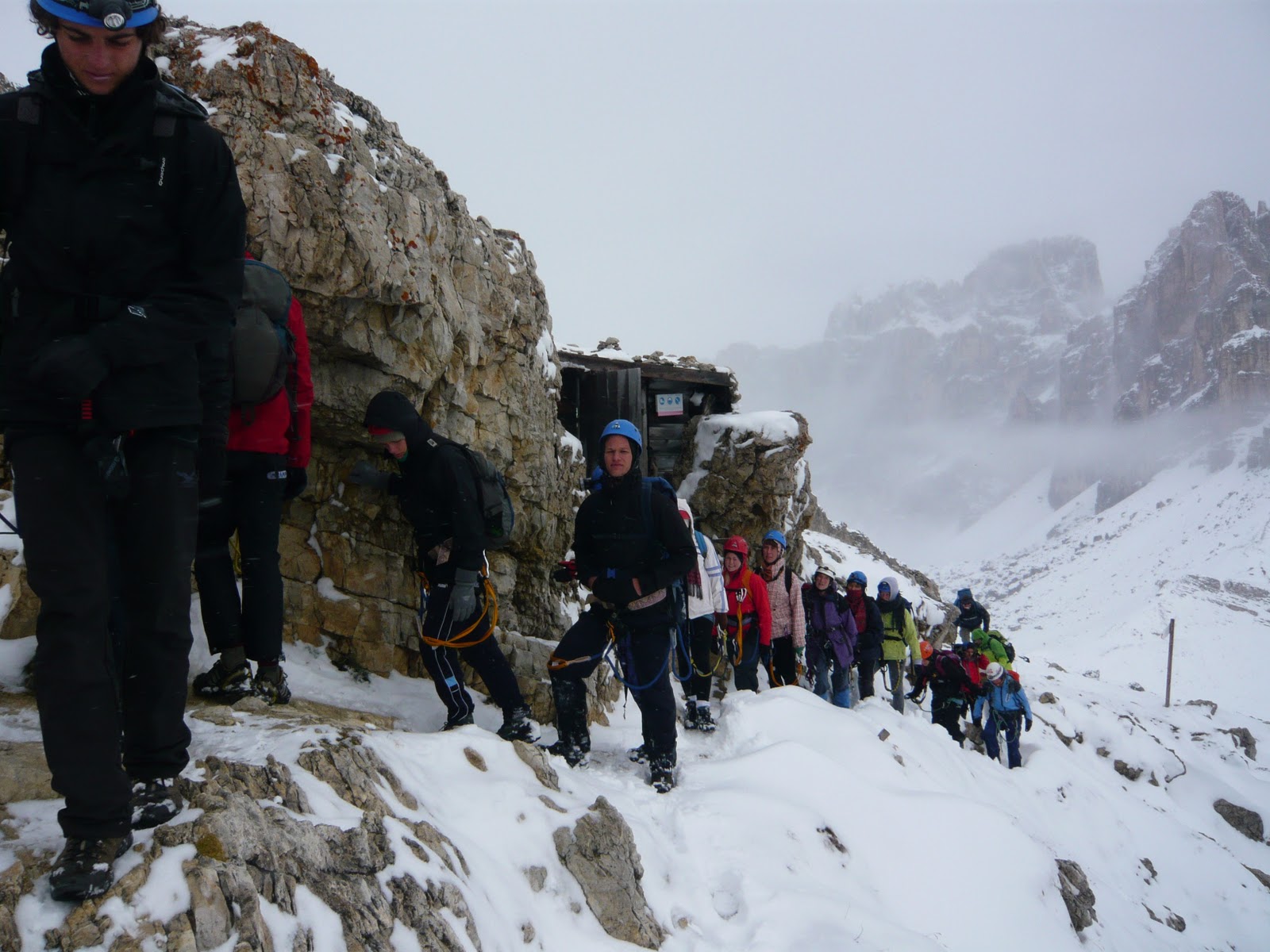
Basically to the right of this path was a sleep slope that led to a cliff, which in turn led to the ground

Lorenzo and Francesco at the door of the tunnel

A view out of one of the WWI gunner positions.
(In the front, you can just see the tip of the plank, which is left over from the war)

A view of the tunnel. Lorenzo is at the front, hiding me, with the others and their lights behind us.

Paola (the teacher) on the extra bit, after the tunnel, where we went to see the canteen and the reconstructed building

This is said reconstructed building, with Patrick and Lorenzo

Before the attack...

...and After
Now these two photos below are of roughly the same view. The bottom one is a bit further zoomed out, though. My main point is that it shows the difference between:

On Friday...

...and Sunday
for some reason I couldn't add any more photos... maybe that's a good thing. Anyway, ciao!
Subscribe to:
Posts (Atom)